Get free quotes from mobile imaging near you
Takes about a minute. Free, no obligation; providers reply to you directly.
A sales rep once handed me a spec sheet for a portable X-ray unit and led with “118 dB dynamic range” like I was supposed to nod knowingly and reach for my checkbook. I had no idea what that meant. Neither did he — he’d copied it from a brochure. That’s pretty much the state of equipment marketing in mobile imaging: an arms race of specs most buyers can’t evaluate, attached to price points most buyers can’t justify questioning.
After spending time with mobile imaging technologists and digging into what the DR systems actually do under clinical conditions, here’s what I found: the equipment gap between providers is much smaller than vendors want you to think, and the technique gap is much larger.
The Short Version:Modern portable DR systems from reputable manufacturers all deliver hospital-comparable image quality. What separates good mobile X-ray from bad is technologist skill, positioning, and workflow — not whether the detector has a marginally higher DQE. Don’t let a shiny spec sheet substitute for vetting the people behind the equipment.
Key Takeaways
- Battery-powered portable DR systems now support up to 1,200 images per charge — battery life is a solved problem for most SNF workflows
- Digital detectors deliver images in seconds; the full acquisition process runs about 1–2 minutes per cassette
- HIPAA-compliant EMR integration and PACS/RIS compatibility are table stakes — any serious provider should have them
- AI-assisted quality tools help, but they don’t fix poor patient positioning or rushed technique
What the Equipment Actually Does
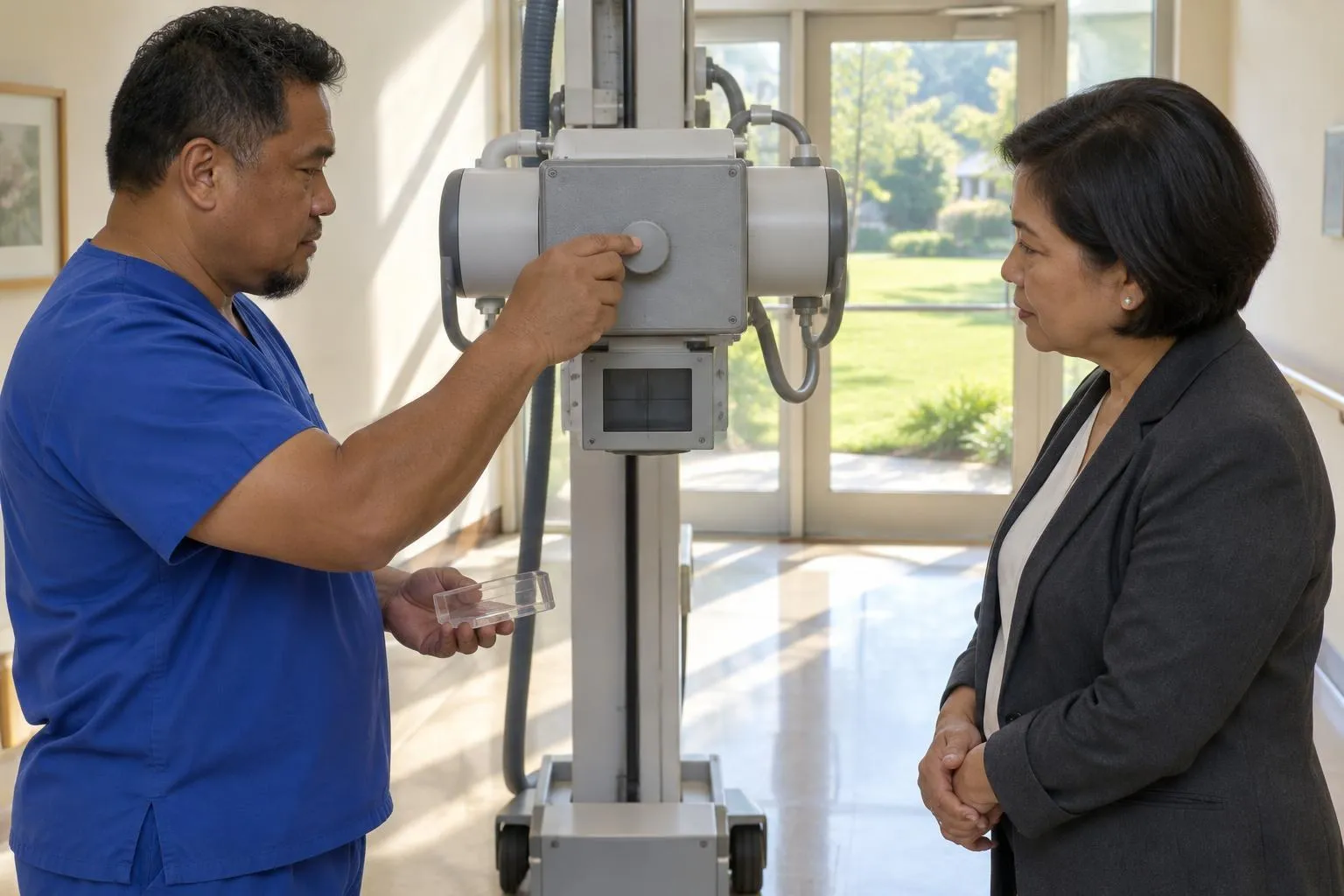
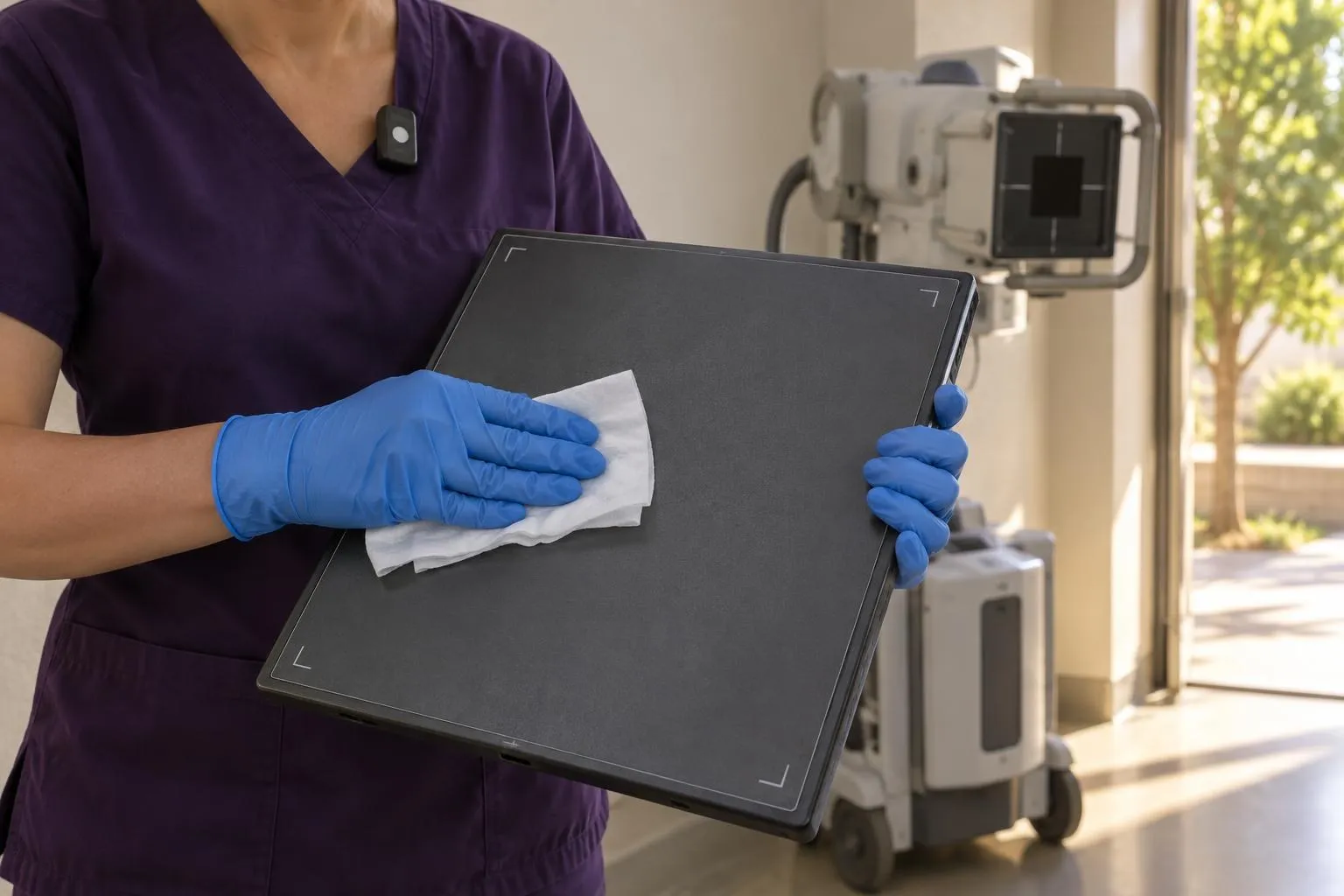
A modern portable digital radiography unit is essentially three things bolted together: a high-frequency X-ray generator, a flat-panel digital detector, and a battery system big enough to run a full day of facility rounds.
The generator output and tube heat capacity determine how quickly you can shoot and how well soft tissue renders. The detector’s detective quantum efficiency (DQE) determines how much of the X-ray signal becomes useful image data — higher DQE means better image quality at lower doses. These are real specs that matter. They’re also specs where the difference between a $45,000 unit and a $65,000 unit from two reputable manufacturers is largely imperceptible in clinical output.
What does matter practically:
| Spec | Why It Matters | Marketing Fluff? |
|---|---|---|
| DQE (Detective Quantum Efficiency) | Real indicator of detector efficiency and dose optimization | Only if used without context |
| Battery life (images per charge) | Direct operational impact — 1,200 images / 9 hours is a real benchmark | No — ask for it specifically |
| DICOM compliance | Required for PACS/RIS integration | Table stakes, not a differentiator |
| Detector size (cm) | Affects chest/abdomen coverage in one shot | Matters for SNF workflow |
| Wireless transmission speed | Impacts same-day turnaround | Relevant, but overhyped |
| ”AI-enhanced imaging” | Assists technologists, automates QC | Often vague — ask what it actually does |
| Weight / wheel size | Maneuverability in SNF hallways and elevator doors | Underrated spec |
The Specs That Actually Move the Needle
Battery capacity is the one hardware spec that creates real operational differences. A system that dies after 400 images forces mid-route charging breaks. Long-life batteries supporting 1,200 images and 9 hours of operation per charge mean a technologist can complete a full nursing facility circuit without worrying about outlets. This isn’t glamorous, but it’s the spec that kills workflows when it’s insufficient.
Detector size matters more than DQE differences between comparable modern systems. A larger detector panel means you can capture a full chest X-ray in a single exposure on a bariatric patient or image an abdomen without stitching. For skilled nursing and home health environments — where patients can’t always reposition — this translates directly to fewer repeat exposures.
Wireless transmission to HIPAA-compliant platforms (look for PACS and RIS integration, EMR compatibility, end-to-end encryption) determines whether results arrive in 45 minutes or three hours. Images transmitted directly to radiologists typically reach interpretation within an hour of capture. That’s the clinical value proposition — not the detector brand.
Pro Tip:Ask any provider candidate to show you their DICOM compliance documentation and their data transmission workflow. If they can’t walk you through how an image goes from cassette to your EMR, that’s a red flag regardless of what equipment they’re running.
What’s Mostly Marketing
“Hospital-level resolution” — nearly every modern portable DR system achieves image quality comparable to many fixed systems. This stopped being a differentiator around 2018. When a vendor leads with this, they’re selling to buyers who haven’t done recent research.
“AI-powered imaging” — embedded AI tools that automate QC checks and provide decision support to radiologists are real and useful. They help address staffing inconsistencies by supporting image quality irrespective of operator experience level. But “AI-powered” on a brochure tells you nothing. Ask specifically: does it flag positioning errors before the tech leaves the room? Does it auto-optimize exposure settings? Vague AI claims are a product of marketing departments, not engineering ones.
Compact design as a selling point — all current portable systems fit through standard doors and elevators. This was a real differentiator in 2008. Citing it now is like a car company advertising “has wheels.”
Reality Check:A provider running a Carestream DRX-Revolution is not automatically better than one running a Konica Minolta AeroDR. Both are DICOM-compliant, both deliver comparable image quality, both have solid battery performance. The technologist operating either system matters more than the badge on the housing.
The Technique Problem Nobody Talks About
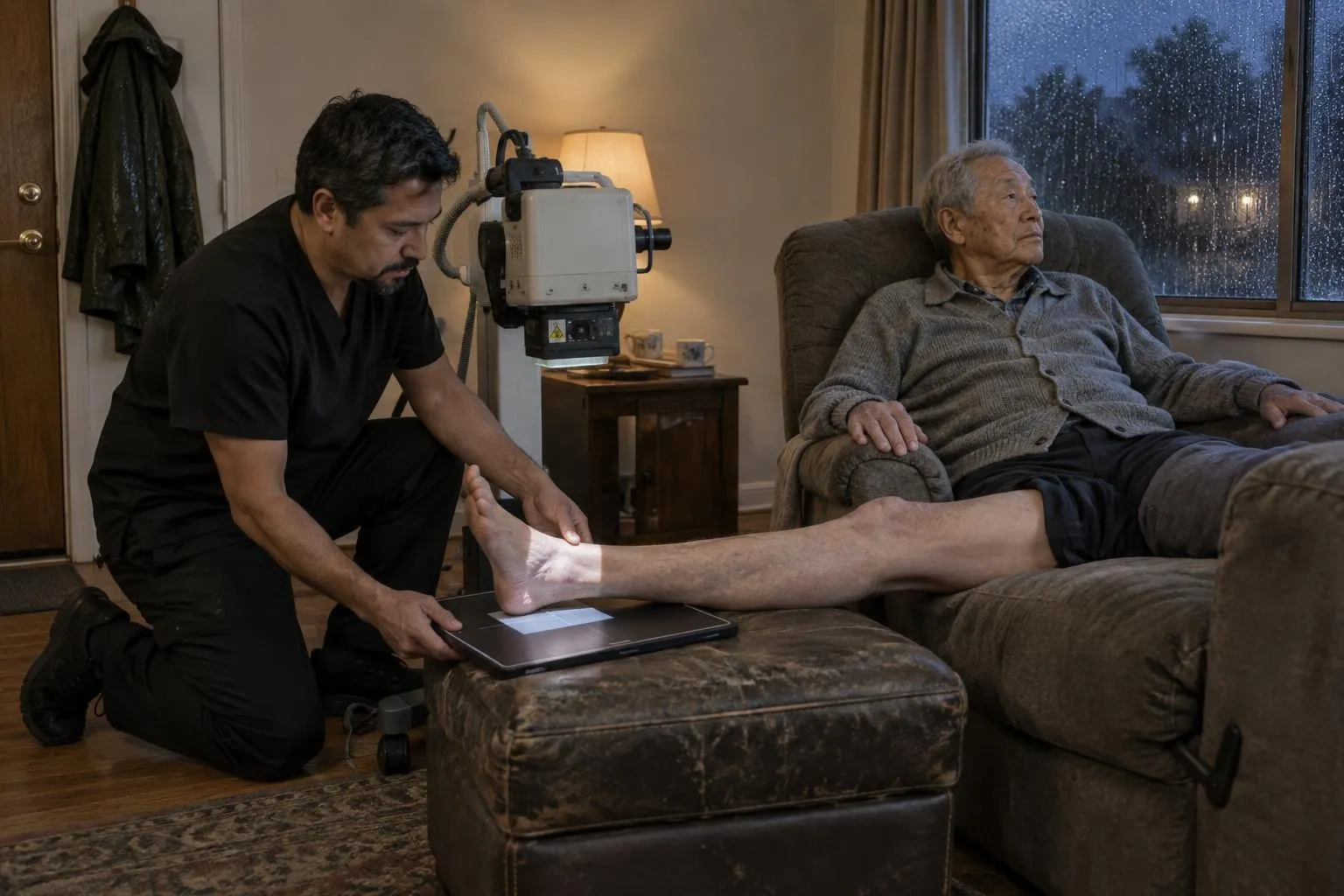
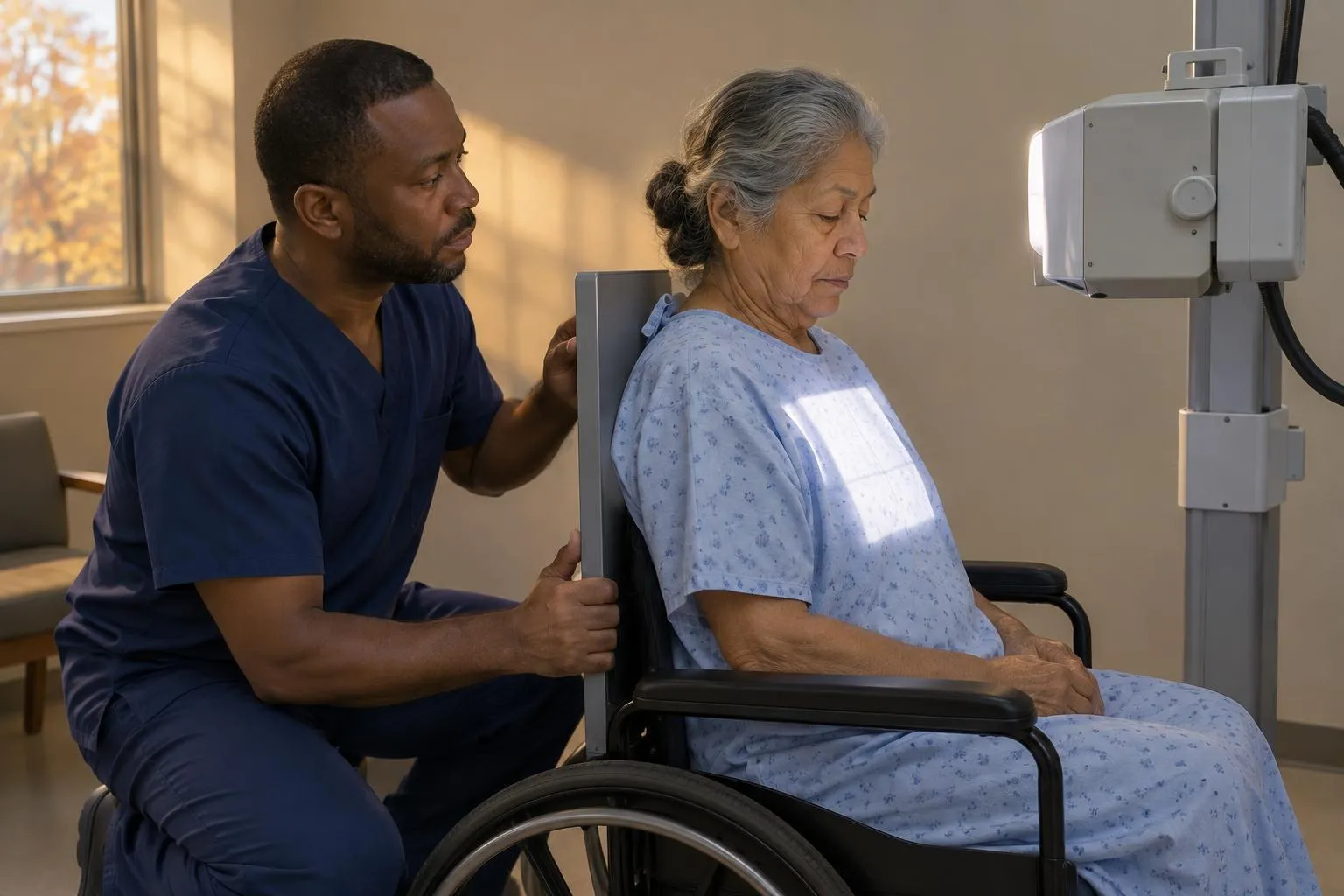
Here’s what most equipment conversations skip entirely: X-ray positioning is a skill, and portable X-ray positioning is a harder skill. A fixed-facility technologist works with a room designed around imaging — adjustable tables, wall-mounted bucky trays, consistent geometry. A mobile tech is improvising in a nursing home bedroom, working around IV poles and bed rails, positioning a detector under a patient who can’t roll over.
Poor positioning means repeat exposures, degraded diagnostic quality, and missed findings. The best DR system on the market, operated by a technologist who rushes through positioning, produces worse images than a mid-tier system run by someone who takes the extra 90 seconds to get the geometry right.
When you’re vetting a mobile X-ray provider, the right questions are about the humans:
- What’s the credentialing requirement for their technologists? (ARRT licensure is the floor)
- How do they handle positioning challenges for non-ambulatory patients?
- What’s their repeat exposure rate?
- How are images reviewed before transmission?
The equipment is competent. The question is whether the person operating it is.
Practical Bottom Line
Modern portable DR equipment is good enough that choosing between providers based on hardware specs alone is mostly noise. The meaningful evaluation criteria are turnaround time, PACS/EMR integration, credentialing standards, and — above all — how the technologists handle difficult positioning scenarios.
For SNF administrators and home health agencies evaluating providers: request a sample workflow walkthrough, ask about transmission time from acquisition to radiologist, and confirm HIPAA-compliant platform details. Those questions will tell you more than any spec sheet.
For context on how mobile X-ray fits into your broader imaging options, the Complete Guide to Mobile X-Ray Services covers the full service model — including when mobile makes clinical and financial sense versus transport to a fixed facility.
The equipment does its job. Make sure the people do theirs.
Done reading? Get quotes from mobile X-ray services near you.
Takes about a minute. Free, no obligation; providers reply to you directly.
Popular cities:
Nick built this directory to help SNF administrators and home health agencies find credentialed mobile imaging providers without wading through services that lack proper ARRT licensure or ACR accreditation — compliance gaps he uncovered when researching portable imaging options for a family member in long-term care.